
distributed by Audio Chocolate, Monitoring, pro audio, Product News, Videos
Kii SEVEN: A Compact DSP Monitor with Cardioid Point-Source Technology
Sep
Kii SEVEN: A Compact DSP Monitor with Cardioid Point-Source Technology
Is the Kii SEVEN the Ultimate Near-Field Monitor?
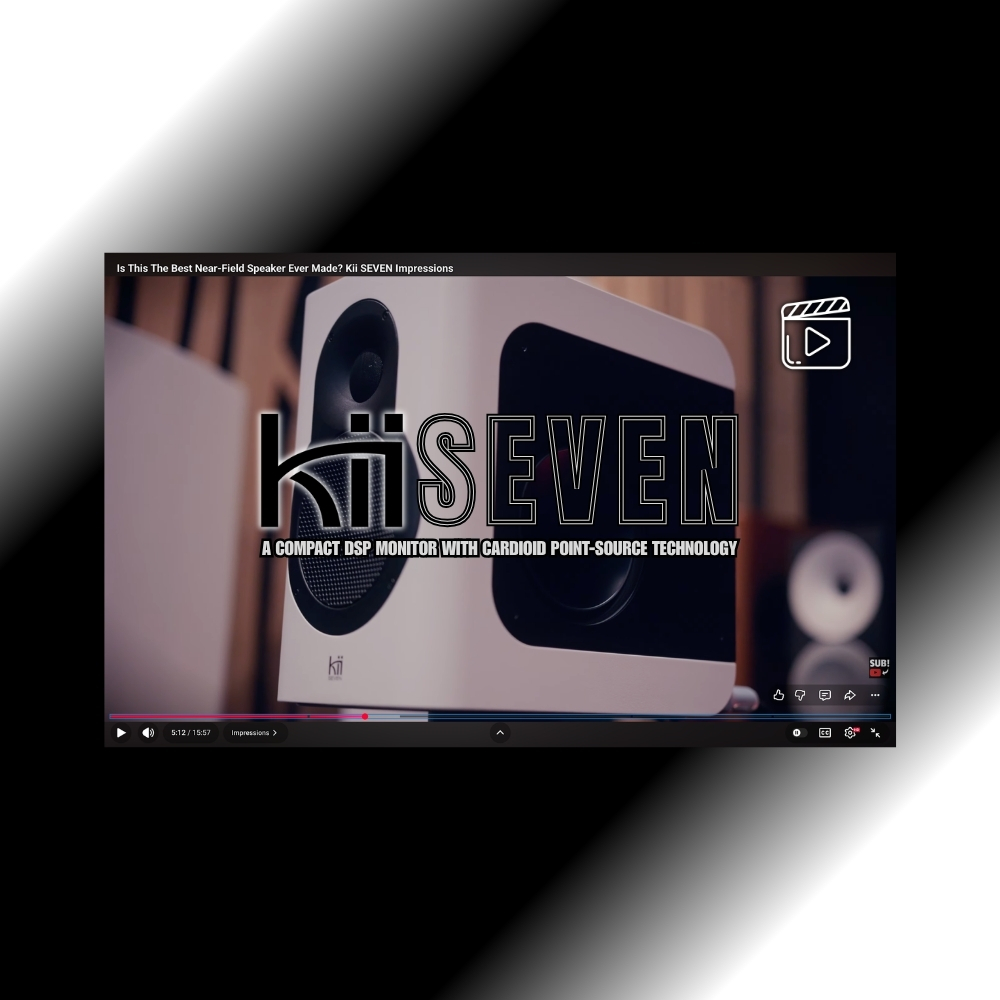
What happens when you combine sophisticated DSP, cardioid point-source technology, powerful built-in amplification and a compact three-way design? In his video review, Project Beats // Joven puts the Kii SEVEN through its paces to find out how this innovative monitor performs in a professional listening environment. After spending time with the speakers, Joven describes the experience as next-level, highlighting the monitor’s clarity, control and ability to retrieve an exceptional amount of detail.
A Different Approach to Near-Field Monitoring
The Kii SEVEN is designed to deliver full-range monitoring performance from a remarkably compact cabinet. Each monitor combines two 6.5-inch woofers, a 5-inch midrange driver and a 1-inch custom waveguided tweeter, with a total of 600 watts of built-in amplification. Sophisticated DSP is used to coordinate the four drivers and optimise the overall response, creating a coherent three-way monitoring system in a compact format.
⬇️ ⬇️ ⬇️ ⬇️ ⬇️


Active Monitors

Cardioid Point-Source Technology
One of the defining technologies behind the Kii SEVEN is its cardioid point-source approach. Rather than simply allowing sound to radiate throughout the room, the system uses DSP-controlled driver interaction and wave focusing to control dispersion and significantly reduce unwanted energy travelling towards the rear. This can reduce the influence of room reflections and help create a more consistent listening experience, particularly in rooms where conventional monitoring can be heavily affected by the surrounding acoustics.

Why Room Interaction Matters
The listening room has a major influence on what we hear from a conventional loudspeaker. Reflections from walls, corners and other surfaces can colour the sound reaching the listening position, potentially making critical decisions more difficult. By controlling its radiation pattern, the Kii SEVEN is designed to reduce much of this interaction and provide a more reliable sound field, including in acoustically challenging studio environments.
Clarity, Control and Detail Retrieval
These are the qualities that particularly stood out to Joven during his listening session. In his review, he describes the Kii SEVEN as delivering exceptional clarity, control and detail retrieval, with an experience that he characterises as next-level. These observations form the centrepiece of the video, with the review moving beyond specifications to focus on what the monitors actually communicate during critical listening.
A Smooth and Detailed Midrange
At the heart of the Kii SEVEN‘s three-way architecture is a dedicated 5-inch midrange driver designed to deliver clarity, detail and precision across vocals and instruments. The custom waveguided tweeter works alongside the midrange and DSP-controlled system to maintain controlled directivity and a coherent presentation, contributing to the monitor’s detailed stereo imaging and natural presentation.

Powerful Low-End from a Compact Cabinet
The Kii SEVEN achieves its compact form factor without relying on a conventional small-monitor approach to low frequencies. Two 6.5-inch Active Wave Focused Woofers provide the low-frequency output, while the integrated amplification provides substantial headroom. Kii specifies a frequency response extending down to 40Hz at -3dB, with a remarkably controlled response through the mid and high frequencies.

DSP at the Core
DSP is fundamental to the Kii SEVEN‘s architecture. Rather than treating digital processing as an optional add-on, Kii uses DSP to align and coordinate the drivers, control the speaker’s dispersion characteristics and provide different operating modes. The monitor offers minimum-phase and minimum-latency modes, allowing the system to be adapted to different production requirements.
Minimum Phase or Minimum Latency?
For recording situations where monitoring latency is critical, the minimum-latency mode is designed to provide virtually immediate playback. When latency is less important during mixing, minimum-phase operation prioritises the monitor’s phase-accurate response. This gives engineers flexibility to configure the Kii SEVEN according to the demands of the particular production workflow.
Flexible Connectivity for Modern Studios
The Kii SEVEN is designed to integrate into a wide range of studio environments. Connectivity includes analogue XLR and TRS inputs, AES/EBU digital connectivity, as well as Wi-Fi, Bluetooth and Dante. This allows the monitor to accommodate conventional professional studio connections while also supporting networked and wireless workflows.
Built for Stereo and Immersive Monitoring
The Kii SEVEN can also form part of larger monitoring configurations. Multiple Kii SEVEN and Kii THREE monitors can be combined for larger listening systems, including immersive monitoring applications such as Dolby Atmos. For stereo setups, Kii Control provides a dedicated hardware interface for managing the system and offers additional digital inputs.


Kii Control: A Complete Monitor Controller
The optional Kii Control expands the capabilities of a Kii SEVEN stereo system by providing a dedicated volume and source-control interface. It adds SPDIF, TOSLINK and USB connectivity, supports PCM up to 24-bit/384kHz and DSD64/DSD128 over USB, and provides access to presets and additional Boundary and Contour settings. The Kii Control connects to the speakers using a single CAT6 cable, carrying both power and data.


Compact Size, Serious Monitoring Capability
Measuring just 20 × 31 × 31cm and weighing 14kg per speaker, the Kii SEVEN occupies considerably less physical space than many traditional three-way monitoring systems. Yet behind its compact enclosure are four synchronised drivers, 600 watts of amplification and the DSP architecture required to control their interaction.
Hear the Kii SEVEN in Action
For this review, Project Beats // Joven spent time listening to the Kii SEVEN and sharing his impressions of its performance. The video provides an opportunity to hear his perspective on the monitor’s clarity, control, imaging and detail retrieval, while also discussing the technology that makes the Kii SEVEN different from conventional near-field monitors.
🤔 Is This the Best Near-Field Speaker Ever Made?❓
🎥 Watch the Full Review: Kii SEVEN Impressions – Project Beats // Joven ⤵️
Explore the Kii SEVEN at Audio Chocolate
The Kii SEVEN is available from Audio Chocolate as a single compact DSP-controlled monitor, as well as a stereo pair with the Kii Control monitor controller. Both configurations combine Kii‘s cardioid point-source technology, three-way DSP-controlled architecture and flexible connectivity in a compact monitoring solution.
Active Monitors
Final Thoughts
The Kii SEVEN takes a fundamentally different approach to compact studio monitoring, combining controlled directivity, DSP, driver synchronisation and substantial built-in amplification in a small three-way enclosure. Project Beats // Joven‘s listening session highlights the resulting clarity, control and detail retrieval, making the review an interesting opportunity to hear how Kii‘s technology translates into a real-world monitoring experience.
👉 Discover the Kii SEVEN for yourself today. 👇
Active Monitors