



Wolff Audio MeMore RJ45 HomeRun Box – Multi-Distribution Hub for Up to 10 MeMore Units
Call for Price
Scalable Analog Distribution for MeMore Personal Monitoring.
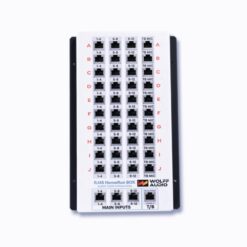
The Wolff Audio MeMore RJ45 HomeRun Box is a scalable analog distribution hub designed to expand your MeMore personal monitoring system. Using standard CAT5 or CAT6 cabling, it distributes a single analog source feed to up to ten MeMore personal headphone amplifiers, creating a clean and efficient monitoring network without bulky analog snakes or complex digital infrastructure. With zero latency, no A/D or D/A conversion, and a fully analog signal path, the HomeRun Box delivers reliable, high-quality audio for studios, rehearsal spaces, live rooms, and broadcast environments.
Wolff Audio MeMore RJ45 HomeRun Box – Multi-Distribution Hub for Up to 10 MeMore Units
OVERVIEW
The MeMore RJ45 HomeRun Box expands your MeMore Personal Headphone Amplifier system with a clean, reliable, fully analog distribution backbone.
Designed specifically for MeMore, the HomeRun Box allows you to distribute a single analog source feed to multiple headphone amplifiers using standard CAT5 or CAT6 cable. The result is faster setup, cleaner wiring, longer runs, and a scalable monitoring system without bulky analog snakes or complicated digital infrastructure.
Whether wiring a control room, live room, rehearsal space, or educational lab, the MeMore RJ45 HomeRun Box keeps monitoring simple and great sounding.
Simple Analog Expansion
At its core, the HomeRun Box functions as a high-quality analog ‘CAT cable mult.’ Four RJ45 input ports carry up to 12 channels of audio plus dedicated talkback, allowing distribution to as many as ten MeMore units when used with Wolff Audio RJ45 adapters.
No networking configuration.
No digital conversion.
No latency.
Just clean analog signal from source to performer.
Why Analog Still Matters
Unlike digital personal monitoring systems, the MeMore RJ45 HomeRun Box maintains a fully analog signal path from end to end.
- Zero latency
- No A/D or D/A conversion
- Maximum reliability
- Full compatibility with existing studio infrastructure
Using standard CAT cabling provides long cable runs, easy replacements, and tidy installations while preserving the sonic integrity MeMore is known for.
Built for Real-World Studios
The compact, rugged design is equally at home in permanent studio installations or mobile and live environments. Because it leverages affordable, readily available CAT5/CAT6 cable, expanding your monitoring system is both cost-effective and future-friendly.
The Backbone of a Scalable MeMore System
The MeMore RJ45 HomeRun Box integrates seamlessly into any MeMore setup, providing a flexible, expandable foundation for personal monitoring systems of virtually any size.
Add more MeMore units as your needs grow – the HomeRun Box scales with you.
KEY HIGHLIGHTS
Scalable Analog Monitoring Distribution
The Wolff Audio MeMore RJ45 HomeRun Box distributes a single analog source feed to as many as ten MeMore personal headphone amplifiers, allowing monitoring systems to grow easily as your studio expands.
Simple Setup with CAT5 / CAT6 Cabling
Using standard Ethernet-style cabling eliminates bulky analog snakes and simplifies studio wiring. Long cable runs are easy to manage while keeping installations clean and organised.
Zero-Latency Analog Signal Path
Unlike digital monitoring systems, the HomeRun Box maintains a fully analog signal chain from source to performer. With no digital conversion or processing, performers hear their mixes instantly with maximum sonic integrity.
Designed Specifically for the MeMore System
Engineered to integrate seamlessly with the MeMore personal monitoring ecosystem, the HomeRun Box works with Wolff Audio RJ45 adapters to distribute up to 12 channels of audio plus dedicated talkback.
Built for Professional Environments
Its compact and rugged design makes it suitable for permanent studio installations as well as live environments, rehearsal spaces, education labs, houses of worship, and broadcast facilities.
FEATURES
- Distributes one analog source to up to 10 MeMore units
- Four RJ45 inputs carrying 12 channels plus talkback
- Uses standard CAT5 / CAT6 cable
- Designed specifically for MeMore with Wolff RJ45 adapters
- Fully analog signal path – no latency, no conversion
- Compact, rugged design for studio or stage use
TECHNICAL SPECS
Product Type: Analog distribution hub for MeMore monitoring systems
Compatibility: Designed for MeMore Personal Headphone Amplifier systems
Maximum Distribution: Up to 10 MeMore units
Inputs: 4 × RJ45 ports
Audio Channels: Up to 12 channels plus talkback
Cabling: Standard CAT5 or CAT6
Signal Path: Fully analog
Latency: Zero latency
Conversion: No A/D or D/A conversion
Ideal Applications:
- Recording studios
- Studio installations
- Rehearsal spaces
- Live rooms
- Educational facilities
- Houses of worship
- Broadcast environments
Related products


MONITORING


Audio / MIDI Interfaces

Headphone Amps


Headphone Amps